Tuesday, April 14, 2009

The Liquor Authority Gets a Wake Up Call


By Gamal Hennessy

Last week the Inspector General raided the offices of the State Liquor Authority. Former SLA employees are being accused of bribing employees to manipulate the system. While the investigation focuses on the gift cards and other petty items offered in exchange for “preferred” treatment, officials need to focus on the underlying situation that created the fraud and clean up the liquor licensing system.

The New York State
Alcohol Beverage Control Law (ABC) states that an application for a liquor license should get an initial review within 30 days. Nightlife operators have complained for years that the review often took 2-3 months because of a lack of inspectors among other issues. Recently, nightlife opponents in the outgoing administration managed to drag out that period to 6-8 months.

Operators became increasingly frustrated with the process, since the investment in a bar or club can’t start to make money until they can sell liquor and they can’t sell liquor without a license. That’s where the “handlers” would come in. For a fee,
these former SLA employees would offer ‘expedited service’ for an application. The IG claims that the service they performed was calling up their friends who still worked in the SLA, and asking for the applications to get moved to the top of the pile. In return, the handlers would give their friends gift cards and, ironically, bottles of liquor. The IG alleges that some applicants got their forms processed in as little as 11 days instead of waiting half a year or more.

It is regrettable that people in positions of authority, however minor, are willing to manipulate the bureaucracy for their own personal advantage. But the larger issue revolves around the system itself. Robert Bookman, attorney for the New York Nightlife Association, sees this raid as the result of a dysfunctional system:

“It takes 8 months to get a liquor license when the law requires it be done in 30 days. Huge investments are sitting and waiting for a license that is long overdue. Is it any wonder that people will get desperate and will do whatever they have to just to get an honest review of their application? That is the real scandal here. Notice there are no allegations that anyone got a license that they were not entitled to. The crime is that the applications were reviewed quickly…the way they are supposed to be reviewed. I am not condoning illegal activity, but no one has been listening about this unlawful, unacceptable wait for liquor licenses before now.”

If the leaders of the SLA essentially broke the law and created a situation where potential operators have to wait 6-8 months for a license, and refused to hire more examiners, then they created the atmosphere for corrupt practices in the Harlem office. The responsibility for this corruption needs to go a lot higher than the clerks who took Applebee’s gift cards. It needs to lead to a revamping of the whole process. Governor Paterson said he supported “
the actions of the I.G.’s office to uncover any wrongdoing that may have occurred within the S.L.A. and is working with the S.L.A. to rebuild the organization.” Hopefully this raid can be the beginning of an overhaul that helps bring jobs and revenue to the state while cleaning up a government agency at the same time.

Have fun.
Gamal

Tuesday, March 31, 2009

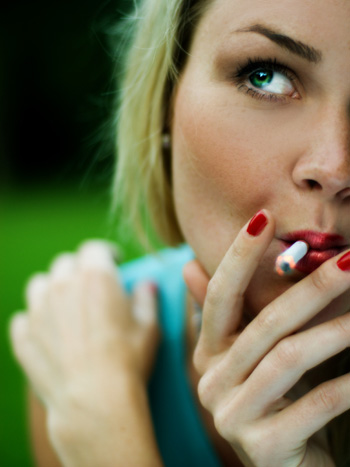
The World's Loudest Cigarette: Six Years of the Smoking Ban


Six years ago this week, a smoking ban was imposed on bars, restaurants and other venues in New York City. While the atmosphere inside bars has improved and there are studies that suggest that there has been a significant improvement in the health of nightlife operators and patrons, there have also been secondary effects that threaten the health of the nightlife industry in general. The city has unintentionally (or perhaps unintentionally) created a situation that puts clubs at odds with local residents and ultimately threatens liquor licenses.


History

Before the election of Michael Bloomberg as mayor of New York City, bars and clubs were bastions of smoking. Federal studies found that 61% of heavy alcohol users also smoked, often performing both acts simultaneously. The image entering a smoky bar and approaching a sexual interest by asking for a light were common in many venues in the city. Anyone who went into or worked in a bar accepted the concept that smokers would be there and that they would be able to smell the smoke on their clothes and in their hair long after they left the venue, whether they smoked or not. Back when the world was young and I worked in Webster Hall, I had to sneak outside several times a night for the chance to breathe fresh air. Cigarette smoke triggers my asthma, so for me working in the basement was like working in a burning building. It wasn’t the smartest thing I ever did, but a
hustler does what he has to do, especially when he’s starting out.

In 2002 after Bloomberg became mayor, one of the first things he pushed for was a ban on smoking in restaurants, bars and clubs. The debate leading up to the passage of the law was hotly contested on both sides. Groups that advocated the ban claimed that operators inside the clubs were the most vulnerable to the dangers of second hand smoke because they were exposed to it several hours a night for several nights per week. They claimed a ban would both improve the long term health of operators and improve nightlife business because it would attract people who didn’t smoke into the environment to spend money. Groups that came out against the ban did not deny the health benefits, but they did argue that there would be economic and social effects that the law did not take into account. They also claimed that there would be increased friction from the community because of the noise generated from patrons standing outside to smoke from 5 PM to 4 AM.


The Sound of Smoking

Some people think that a few people standing outside a venue will not substantially increase the level of street noise. But that concept only considers the smokers themselves. They don’t see that smokers, especially female smokers, provide a powerful incentive for groups of fanatics to hang out in front of a club, especially the ones who didn’t get into or got thrown out. In a twisted effort to get noticed and prove their superiority, these individuals will shout, get into fights, honk their horns if they are in their cars, or try to talk to girls from their cars and back up traffic behind them which causes other cars to blow their horns. This sad mating ritual cacophony will die down when the girls finish smoking and go back inside, but it will begin again when the next group of girls comes out of the club to take their place.


The relationship between street noise and smoking outside should not have come as a surprise to anyone involved in the development of the smoking ban since the NYNA informed city that the smoking ban would lead to noise complaints. But when operators requested the ability to hire Paid Detail officers to deal with the inevitable noise the result was the worst of all options. The smoking ban was put in place and the request for Paid Detail was rejected, allowing the smoking ban to become a major contributor of street noise. When street noise increases, 311 complaints from local residents increase. When complaints increase, local community boards can use those complaints to have a venue’s liquor license revoked. Without a liquor license, a bar or a club can’t compete in the market and is forced to close. There is a direct relationship between the smoking ban and the increase in noise complaints against clubs. As the ban enters its 6th year operators need to find a way to keep patrons healthy and stay opened.


Coping Strategies

Different venues use different tactics to deal with the ban. Any venue that has been built or renovated since 2003 could factor the law into their design. The ones that could afford it added heated courtyard lounges like Cielo, rooftop access like Above Allen or fire escape access like APT to give smokers access to the open air without putting them out on the street. Venues that don’t have that option rope off areas in front of the venue to separate the smokers who already made it past the velvet rope from the throngs still trying to get inside.

There are also growing instances of venues that do not rope off areas out front, or create special sections for them. Some operators have come to the conclusion openly or privately that it is
easier and more cost effective to simply break the law. Smoking in clubs reported to be on the rise in New York City, either because enforcement has dropped off, or because the fines are low enough that paying them costs less than complying with the law or getting noise complaints. While this minority of operators might not openly reject the law, they have come to the conclusion that the cost of paying the fine is less than the cost of erecting smoking areas or subjecting their liquor licenses to revocation based on noise complaints from smokers standing outside. Some solutions have worked better than others, but one thing the clubs won’t do is discourage smoking by their clientele since by some operator estimates, smokers account for 40% of patrons.


A More Viable Solution

There is an alternative that protects the health of patrons and operators, keeps noise levels down outside of venues and allows patrons to smoke all at the same time. There are air filtration systems on the market that have been approved by the Department of Health and are currently used by infectious disease wards in hospitals to clean the air. These systems reportedly are the size of a humidifier and one of them can keep 1,250 square feet of interior air cleaner than the air in Central Park, even if 60% of the people are smoking inside. The NYNA proposed that if a venue was primarily a bar, lounge or club and not a restaurant then they could have one filter installed for every 1,250 square feet of interior space and become exempt from the ban. This request was not included in the final version of the law.


The best options available for the industry are to continue to lobby officials on the state or and local level that patrons can smoke inside without health risks, through the use of technology like filtration units. They can also try and work with local community leaders and law enforcement to gain the power to control or reduce noise outside the venues through Paid Detail. Finally, they could work to sever the links between street noise and liquor licenses so that loud patrons don’t lead to closed venues. Whatever tactic operators decide to use they need to insure that the smoking ban isn’t harmful to nightlife health.

Have fun.
Gamal

Wednesday, March 18, 2009

Are Police the New Health Inspectors or Tax Collectors?


Imagine this. You’re sitting in your favorite bar nursing a drink and wondering how you’re going to convince the waitress to give you her phone number. Without warning three cops walk in, push behind the bar and start poking around with their flashlights, making everyone in the room very nervous. As you gather up your belongings and discreetly make your way towards the door, would you assume that this was a raid? Would you guess that the cops were looking for drugs, guns or child pornography? Would you believe they were looking for fruit flies?

Fruit flies are drawn to alcoholic beverages and bar owners are required by the state law to keep them out of liquor bottles as a matter of public health. As part of the routine inspections by the Department of Health (DOH) bars are inspected for fruit flies and any venue that has fruit flies on or in the bottles is subject to a fine that could run between $700 and $1,000 per infested bottle. This is a normal part of the nightlife business and isn’t really a cause of concern among operators. The problem arises in the way the law has recently been enforced. Even if you are a nightlife native who frequents various venues, you have probably never seen a DOH inspection taking place. That’s because inspectors keep a relatively low profile while conducting their business. Patrons usually have no idea what is going on and they don’t have to. But there have been reports of layoffs at the DOH, which could mean fewer inspectors. But inspections still need to be conducted, especially since every violation can lead to fines that cash strapped city and state governments are desperately looking for. So somehow the DOH has been replaced with the NYPD who is anything but low profile when they come into the bar.
One operator commented on the climate that the NYPD creates; “By sending a uniformed officers from the NYPD behind your bar with a flashlight looking for fruit flies and whatever else they can find at the height of your business hours creates a stressful situation for you and your customers. It looks like a crime was committed in your place and they are looking for evidence. It gets people talking about your establishment in ways you don't want.”

Bar and lounge owners in various parts of the city have described this scenario happening in their bars with increasing frequency. Some operators think that the NYPD has been given a mandate to perform random inspections as a way to “find” violations and provide the city and the state with much needed revenue. Various operators have voiced opinions about the situation: “What they are thinking is that they are going to get funds for a broke state and city no matter what the consequences. No thought is given to the outcome except that those cops better come back with some violations. With cops conducting their random inspections, we are at the whim of whoever is giving these cops the orders to do these. It is much more invasive and detrimental to our businesses. “I don't think this has anything to with revenge against a particular venue. All bars are suffering this treatment. This has more to do with the city's need to collect more revenue in the shape of fines and the fact that they've laid off a number of health inspectors.”

So instead of increasing state revenue by working with the nightlife industry, local government is trying to increase state revenue by intimidating and attacking it, using the police as its instrument. We have pointed out in previous articles that ending the backlog in liquor license applications and increasing the number of venues would actually increase state revenue significantly. And as dangerous as fruit flies are to public health, the police are probably better utilized deterring and preventing crime outside of venues instead of poking around behind the bar looking for bugs. We know that the state wants to use liquor consumption as cash cow and nightlife is an economic resource that the city can use for its benefit, but only if it takes more of a cooperative stance instead of being antagonistic.

Unfortunately, some operators don’t see things getting better because they don't feel the lobbying efforts are strong enough to support their position. “With all due respect to our lobbying groups, I really don't think they have the stomach for this kind of fight. We are just going to have to put up with this intrusive behavior by our government and keep our bars as clean as possible.”

So if you see a couple of cops climb behind your favorite bar, it might not be a raid. It might just be an abusive health inspection.

Have fun.
Gamal

Tuesday, March 3, 2009

So Where Are the Cops?


By Gamal Hennessy

Several people were stabbed over the weekend outside a TriBeCa club. The violence that occurred is the latest incident involving this venue and is sure to be used as an example of out of control nightlife here in the city. Unfortunately, incidents like this might be inevitable given the current position of the New York Police Department. Until nightlife venues are given the same police protection as other venues, violence will be a part of the nightlife experience.

Deco has several aspects to it that make it a less than ideal example of a New York venue. According to
Matthew Chayes of New York Newsday, Deco has been operating without a liquor license since January 3, 2009 and it was the scene of two shootings in 2007. On Saturday night, two people were allegedly slashed with razor blades by Mario Olmedo. Later that same evening there was a report that three more people were attacked with blades outside the same venue.

Newsday wasn’t able to contact the operators of Deco for a statement, but the ripples are already being felt in the industry. Operators who were planning to move the Flatiron performance space
Cutting Room to TriBeCa withdrew his scheduled appearance before the community board yesterday because he didn’t want the backlash from Deco to influence the decision on his liquor license.

It is an unfortunate fact of nightlife that
fanatics and amateurs get most of the attention when it comes to news stories about nightlife. Very few pages are written about the tens of thousands of patrons who go out, have a good time and get home safely without slicing each other up in the street. It is objectionable that these incidents occur in spite of the fact that nightlife advocates have repeatedly requested the ability to have uniformed police officers patrolling the streets near venues during peak hours. One of the major points that came out of the Nightlife Summit of 2006 was a specific request by the New York Nightlife Association to have paid police patrols outside clubs to enforce laws that club security can’t enforce outside the venue. This request was, and continues to be rejected by the NYPD because it could potentially breed “corruption between the club owners and the cops.”

Serious
violence is rare in nightlife, but as long as there are fanatics out there, the potential for violence exists. But while the NYPD protects itself from potential corruption, operators are held responsible for violence that they do not have the authority to control. They suffer the wrath of the irate community board members looking for any reason to shut down our venues. We as patrons are left to fend for ourselves among the fanatics when we go out, creating a situation where some of us will have to go to the hospital when our night is over.

Have fun.
G

Tuesday, February 24, 2009

Balancing the Budget at the Bar


By Gamal Hennessy

Everyone knows we are in a recession. Not many people are sure how we’re going to get out of it. Many lawmakers on the state level think one of the keys to generating revenue and balancing their budgets will come from increases in so called ‘sin taxes’. This would mean that the state tax on liquor could go up. If the taxes on liquor go up, how long will it be before the cost of drinking goes up too?

Andrew Cleary of Bloomberg.com reported that state law makers across the country are planning to increase the taxes on beer, wine and spirits in an attempt to close budget gaps through increased taxation. At the same time, stocks of beverage companies have been decreasing up to 40% in the last 12 months as people tighten their belts in the face of economic uncertainty. While lobbyists for the liquor companies plan to fight against these measures, victory for them appears unlikely. If they get taxed, then the operators who serve the liquor have to pay more per bottle of liquor. If they have to pay more to buy liquor, guess who’s going to probably pay more to drink it….

I’ll give you a hint…it’s you. But before you bang your fist on the desk and curse the greedy club owner for stealing your hard earned wages, it would help to understand the economics of serving drinks.

Of course, the main source of revenue for a bar is the drinks that are served. Each drink also represents a specific cost that the bar has to pay before the bartender can throw that little napkin down on the bar and ask you what you want. The price the bar pays to serve each drink is based on the cost of the ingredients, the serving costs and the glass costs which combine to become what business plans call the cost of goods sold.

Understanding how the cost of goods sold works, we need to examine a drink and the costs associated with it. Let’s take a Vodka/ Cranberry for example because it’s simple. You go to the bar order it and the bartender charges you $8. You are shocked.

According to the
Professional Bar & Beverage Manager’s Handbook, there are about 25 ounces of liquor in a 750 ml bottle. So if a bar uses a bottle of Absolut with a wholesale price of $15, then every ounce of vodka costs $.60 ($15 ÷25 ounces). If the bar puts 4 ounces of vodka in each drink, then each bottle can make about 6 drinks. So for every $15 the bar spends on liquor it pulls in $48 (6 drinks x 8 dollars).

But a vodka cranberry has more than vodka in it. Let’s say that the cranberry juice is $.20 per ounce and the ice and lime are $.05 each. When the bartender makes your drink, let’s figure a 4 to 3 ratio in a 10 ounce rocks glass. That means roughly 4 ounces of vodka ($2.40) and 3 ounces of cranberry ($.60), ice and the little lime wedge ($.10). Based on our initial prices, the bar pays $3 for the materials to serve you the drink. If the drink is $8 that means there is $5 in profit.

At this point, you might assume that you need to open a bar and make some money. Before you apply for your liquor license, you need to consider the additional costs. Drinks don’t just appear in front of you. This isn’t Star Trek. The bartender who served you the drink has to be paid. The bar back who gets the ice and cleans up the empty glasses has to get paid. Each glass that drinks are served in have to be paid for and each one has a potential to only be used once because it could chip or break completely in the hands of the drunk and clumsy. All those costs could equal an additional $.50-$.75 per drink. There is a tax on the liquor that figures into the price. If that tax goes up, then the cost of the drink goes up too.

Then you have to take a look at where you are. Unless you’re passing around a bottle of Mad Dog around a barrel fire by the highway, the space you’re drinking in has to be paid for. There is the rent for the venue and the taxes associated with that real estate (keep in mind that the cost per square foot in New York City is among the highest in the country). There are entertainment costs whether you’re talking about a satellite TV sports package, a DJ, a band or an internet jukebox. There are costs associated with the furniture you’re sitting on. There is a cost for the décor. There are costs for the security guard or hostess standing out front. The license for the computer system and touch screens that the bartenders use isn’t shareware. It costs money. Utilities like water, gas, telephone, heat, electricity and website maintenance associated with the venue also have to be paid. When you take all of that into account, you might have added another $2 to the cost of serving you that drink.

Then there are costs for things that patrons don’t see at all. There are insurance costs. There are costs for the lawyers, accountants and other professional services that a business needs. There are costs for maintenance associated with keeping things like the lights and the toilets working. You’re now talking about another $.50 to $1 cost per drink.

Finally, you have optional costs like marketing, advertising, uniforms for the staff and laundry costs for those uniforms. Or promotional deals like happy hour, two for one specials and other events designed to get people in the door by lowering the price of the drinks. If you decided to include these costs, tack on another $.20-$.50 per drink.

Now that $8 might cost the bar more than $7 to serve you. That leaves a per drink profit of less than $1. While that can be a decent return if you serve thousands of drinks per night, it doesn’t leave much room for error. If the tax goes up enough, most or all of that profit could be gone.

Of course, there are other ways a club can generate money, like covers, bottles and corporate parties. And
if the state decided to let more bars open, it might not have to raise the liquor tax to generate more revenue. But this is not an argument to make you feel sorry for operators. The professional ones can keep costs down and be very successful, even in this economy. It is meant to serve as a more realistic look at the price a bar has to pay to keep the doors open. We want you to avoid sticker shock when you slide up to the bar. Just take a deep breath, pay for your drink and toast the inevitable end of the recession.

Have fun.
Gamal

Thursday, February 19, 2009

Where is New York’s Nightlife District?


By Gamal Hennessy

Many major cities have designated areas where nightlife concentrates. Vegas has the Strip. New Orleans has Bourbon Street. South Beach has Ocean Drive. London has Leicester Square. New York has pockets of venues scattered all over the city, but what if there was a central area that was easy to get to, isolated from local residents, and big enough to house the next generation of mega clubs? Could something like that work here? Would we want it to?

Diane Vacca of
Chelsea Now reported last week that members of community boards 4 and 5 in Midtown are in the initial stages of a plan that would designate areas in the Garment District (between 34th and 41st Streets and 6th and 9th Avenues) as a manufacturing zone. By using a non residential area for larger nightclubs like the venues currently in West Chelsea, the boards hope to give the residents of the quality of life they are looking for while providing space for a vital part of New York’s culture and economy.

Clubs have had conflict in recent years with local residents, community boards and police where local residents complain that the club’s activities are detrimental to the neighborhood and club operators complaining that they don’t have the tools or authority to solve the problems and remain in business. The
encroachment of residential buildings into traditional nightlife areas has exacerbated the problem, which probably had a lot to do with this proposal.

Creating an Ocean Drive in Midtown wouldn’t radically alter the geography of most of the cities venues. Local bars, live music venues, lounges, speakeasies, and wine bars would still flourish all over New York. But mega clubs like the historic Palladium,
Roxy and the Limelight, recent venues like Crobar and Lotus and current clubs like Webster Hall and Home need more space, generate more street noise and cause more late night traffic congestion than the smaller venues. Creating an area for them could help isolate the inevitable issues that come up.

There are at least two issues with the current plan, both turn on economics. The first question is “How do mega clubs fit into the future of New York nightlife?” The desire for operators to sink money into a mega club might not be very strong.
Real estate costs are still fairly high, even in a recession. Liquor licenses are still a time intensive process that can tie up an investment for up to a year. Operating costs might be prohibitive in this district if patrons are planning to hop from club to club like in New Orleans, but are unwilling to pay substantial covers five or six times in one night. And the ability to pack a mega club with patrons on a consistent basis might be challenging without a point of difference to set them apart from the club next door. Steven Lewis has noticed a dispersal of nightlife from a few large venues to many small ones. In that kind of environment, can a mega club survive?

The second issue has to do with the zoning of the area itself. Ms. Vacca reports that the city is unwilling at this point to rezone the area for a nightlife district. Altering their position may take some time. Even if they succeed, operators run the risk of sinking investment capital into properties in a nightlife district only to find that the area is rezoned for residential once they make the area trendy enough for residential developers. This pattern has played itself out in the Meatpacking District and West Chelsea. Vegas and South Beach have created nightlife zones and maintain that status. If a similar New York zone is going to exist, local government needs to have the same commitment to maintain it.

Neither of these obstacles is insurmountable. A specific nightlife zone could spark
growth in nightlife similar to what we saw in the mid 1970’s with the rise of Studio 54. Fresh capital and new ideas like a nightlife zone could be the start of a new age in the nightlife industry.

Have fun.
Gamal

Saturday, January 31, 2009

Be Aware, Take Care


By Gamal Hennessy

We go out to have a good time. We want to forget the recession, the housing slump, the credit crisis and the soft job market. We want to drink, dance and seduce each other for a few hours before reality sets in again. The last thing we need is for thieves, pickpockets and scam artists to invade our refuge and make us even poorer than we were before by stealing our wallets, clothing or purses. But that’s what’s happening and this is what people are trying to do about it.

The NYPD recently approached the New York Nightlife Association with an educational campaign to help patrons guard against petty crime in the clubs. While most of the advice is common sense and straight forward, a little prevention can go a long way. Patrons are in a vulnerable spot. They are often intoxicated, literally in the dark and focused on everything except their personal belongings. Operators can only watch and do so much (like coat check or to a certain extent security guards) to prevent theft. This gives predators space to operate. Ultimately, we are responsible for our own stuff, but the NYPD flyers can make us a little more vigilant on the dance floor.

The underlying dynamic to this situation is threefold. First, there is a
historical tendency for different types of crime in nightlife to rise in a down market. The city is trying to reverse that trend in an attempt to maintain its reputation as a safe city for tourism. Second, nightlife itself doesn’t need the negative publicity of higher crime in a time when patron spending is already down. Any steps taken to make the public feel safer are helpful for the bottom line. Finally this gesture between the police and nightlife comes at a time when relations have been slightly strained. The safety flyers might not settle the allegations of phony drugs busts and potential law suits but like the crisis in the Middle East, any steps toward reconciliation have to be taken with cautious optimism. If the NYPD and the NYNA continue to focus on the well being of patrons instead of attacking each other, then thieves and scam artists will have less room to maneuver and we can escape in relative peace.

Have fun.
G

What’s your opinion? We’d like to know.